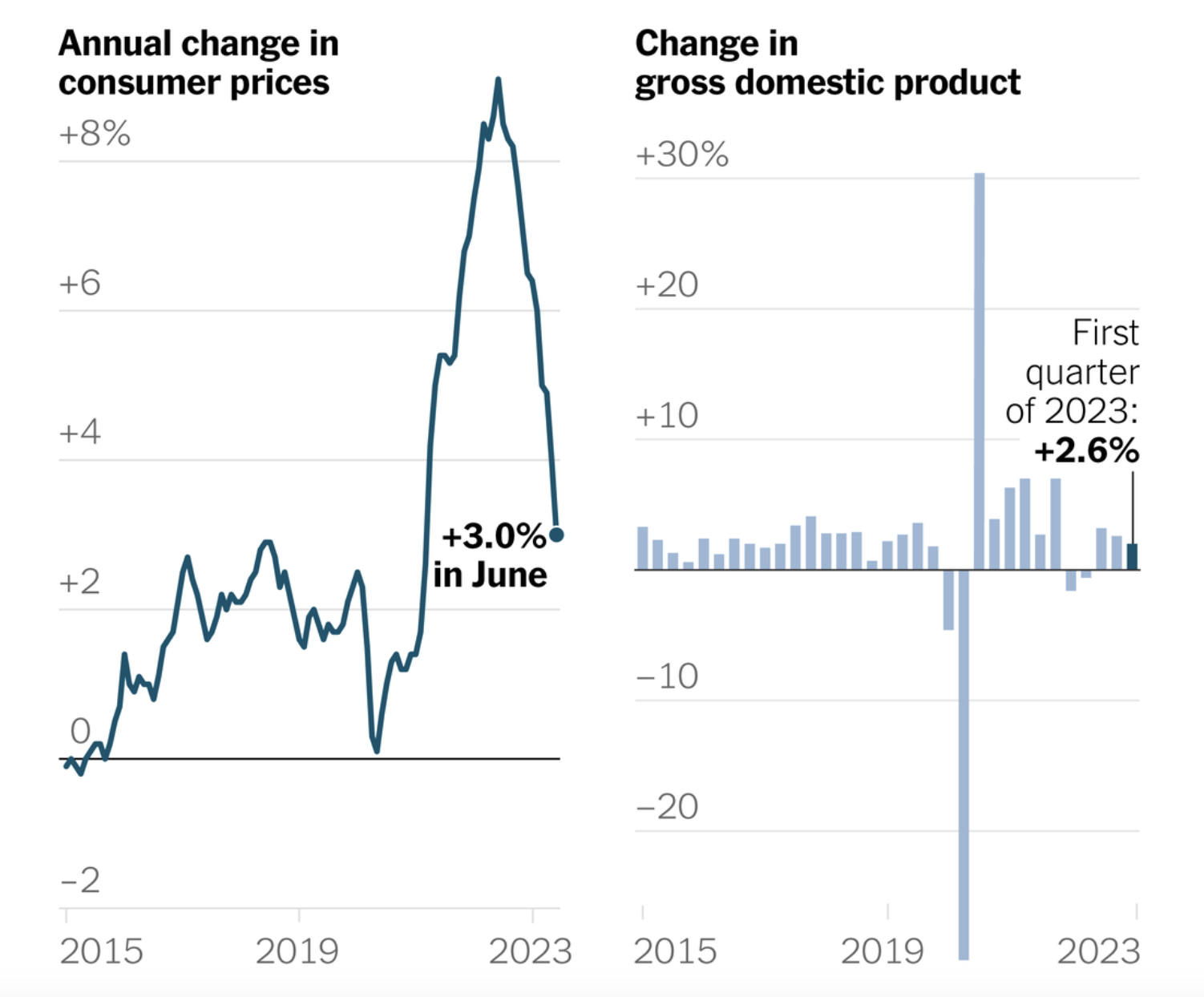
The charts below, by our colleague Ashley Wu, capture the recent trends. Inflation is both way down and still somewhat elevated, while economic growth has slowed but remains above zero. 
Source: Bureau of Labor Statistics; Bureau of Economic Analysis Today’s newsletter walks through the dove-vs.-hawk debate as a way of helping you understand the current condition of the U.S. economy. |
The doves emphasize both the steep recent decline in inflation and the forces that may cause it to continue falling. Supply chain snarls have eased, and the strong labor market, which helped drive up prices, seems to be cooling. “A happy outcome that not long ago seemed like wishful thinking now looks more likely than not,” the economist Paul Krugman wrote in Times Opinion this month. |
Economists refer to this happy outcome — reduced inflation without a recession — as a soft landing. The doves worry that a September rate hike could imperil that soft landing. (Already, corporate defaults have risen.) |
“It’s crystal clear that low inflation and low unemployment are compatible,” Rakeen Mabud, an economist at the Groundwork Collaborative, a progressive think tank, told our colleague Talmon Joseph Smith. “It’s time for the Fed to stop raising rates.” |
A recession would be particularly damaging to vulnerable Americans, including low-income and disabled people. The tight labor market has drawn more of them into work and helped them earn raises. |
The hawks see the risks differently. They point to some signs that the official inflation rate of 3 percent is artificially low. Annual core inflation — a measure that omits food and fuel costs, which are both volatile — remains closer to 5 percent. |
“The Fed should not stop raising rates until there is clear evidence that core inflation is on a path to its 2 percent target,” Michael Strain of the American Enterprise Institute writes. “That evidence does not exist today, and it probably will not exist by the time the Fed meets in September.” (Adding to the hawks’ case is the fact that big consumer companies like Unilever keep raising their prices, J. Edward Moreno of The Times explains.) |
Fed officials themselves have argued that it’s important to tame inflation quickly to keep Americans from becoming used to rising prices — and demanding larger raises to keep up with prices, which could in turn become another force causing prices to rise. |
At root, the hawk case revolves around the notion that reversing high inflation is extremely difficult. When in doubt, hawks say, the Fed should err on the side of vigilance, to keep the U.S. from falling into an extended and damaging period of inflation as it did in the 1970s. |
And where do Fed officials come down? They have the advantage of not needing to pick a side, at least not yet. Between now and September, two more months of data will be available on prices, employment and more. Powell yesterday called a September rate increase “certainly possible,” but added, “I would also say it’s possible that we would choose to hold steady.” |
As our colleague Jeanna Smialek, who covers the Fed, says, “They have every incentive to give themselves wiggle room.” |
- The Fed’s economists are no longer forecasting a recession this year.
- Powell noted that the labor force has been growing. “That’s good news for the Fed, because it helps ease the labor shortage without driving up unemployment,” Ben Casselman wrote.
- Responding to a question from Jeanna, Powell said it was good that consumer demand for the “Barbie” movie was so high — but that persistently high spending could be a reason for a future rate increase.
- Stock indexes rose after the Fed announced the increase, but fell after Powell delivered his economic outlook.
|
|